Confluent architecture
Confluent is built on a client-server architecture: management nodes run the confluentd service, acting as the central control point. Clients interact with the service through the command-line tools, the web UI, and the REST API, so administrators can manage clusters using their preferred interface.
The confluent service can be deployed as a standalone server in environments where high availability is not a priority. For larger or mission-critical deployments, multiple confluent instances can be configured to provide both scalability and fault tolerance.
The diagram below illustrates the architectural design of confluent:
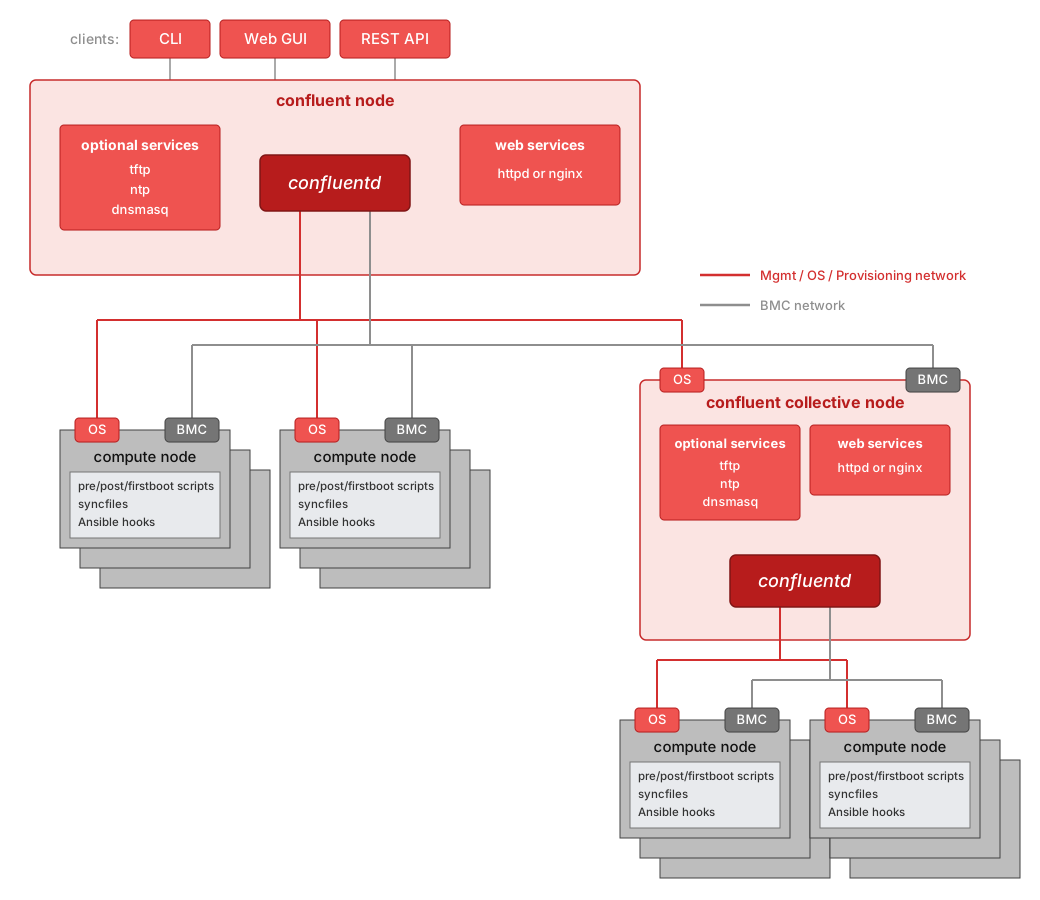
A confluent deployment consists of four fundamental components:
- Confluent node
- Confluent collective node(s)
- Compute nodes
- Networks
Confluent node
In any confluent deployment - whether standalone or in collective mode - there must be one initial server designated as the confluent node, which is the first to run the confluentd service. This node serves as the foundation of the management infrastructure and can be either a physical or virtual server where the confluent software is installed. Once operational, it orchestrates the provisioning and configuration of the entire cluster.
The confluent node stores and maintains a database that includes information about all managed nodes, groups, OS deployment profiles, and their associated attributes. To support operating system installation and other provisioning tasks it also runs a web server (httpd or nginx), and can be complemented by optional network services:
tftpdfor PXE booting clients (not needed with pure HTTP boot)chronyd/ntpdfor time synchronization of the clusterdnsmasqfor DNS and/or DHCP - confluent can generate its configuration from the node attribute database withconfluent2dnsmasq, and maintain/etc/hostsentries withconfluent2hosts
Confluent collective node(s)
A multi-instance setup is managed through collective mode, which enables multiple confluent servers to work together as peers, providing a scalable, resilient, and highly available management infrastructure for large clusters.
Traditionally, very large clusters have a head node and one or more service nodes. The service nodes are subordinate to the head node and help offload tasks to reduce CPU and network load. A major drawback of that architecture is that if the head node fails, the service nodes typically become non-functional as well.
Confluent takes a different approach: in a collective deployment, all members are treated as equals - there is no strict hierarchy between "head" and "service" nodes. Administrators can still organize deployments hierarchically for practical reasons, designating one node as the primary system and others as collective members responsible for subsets of the infrastructure based on network topology or workload distribution. See confluent collective architecture for the design details and example topologies.
A collective node is installed and configured like a standalone confluent node. Its primary role is to share the management workload, reducing pressure on any single node. Beyond load balancing, the collective also provides high availability and failover: if one member becomes unavailable, the remaining members continue to operate.
Compute nodes
In a confluent-managed cluster, compute nodes are fully orchestrated by confluent - from initial hardware discovery and configuration to bare-metal OS installation and ongoing lifecycle management. Deployment behavior can be customized per profile with pre/post/firstboot scripts, synchronized files, and Ansible playbooks.
The term "compute node" is used generically within confluent to refer to any node managed by the system. This includes a wide variety of logical server roles such as CPU nodes, GPU nodes, login nodes, storage nodes, and more. Regardless of their specific function, all of these nodes are provisioned and maintained through the same unified confluent framework.
Networks
In general, there are at least two networks in a large cluster environment: the BMC network and the management/provisioning network.
BMC network
Every managed server contains a baseboard management controller (BMC) - on Lenovo ThinkSystem servers this is the XClarity Controller (XCC), the integrated service processor consolidating system monitoring, video control, and remote presence.
The BMC network is used by confluent to control nodes out-of-band via the service processor. In some configurations the BMC is set to "shared mode", using the same physical interface as the management and provisioning network, so out-of-band and in-band traffic share a single physical connection. This simplifies cabling and reduces additional hardware requirements.
Management and provisioning network
The management and provisioning network is used by confluent to install operating systems and to manage compute nodes in-band - modifying OS settings, copying files, installing additional packages, and applying security configurations. Both the confluent node and the in-band network interfaces of the compute nodes are connected to this network. In large cluster environments, collective nodes can be configured to distribute the workload, reducing the load on a single confluent node and enhancing scalability and reliability.